One evening this week my wife showed me her phone and asked: is this you?
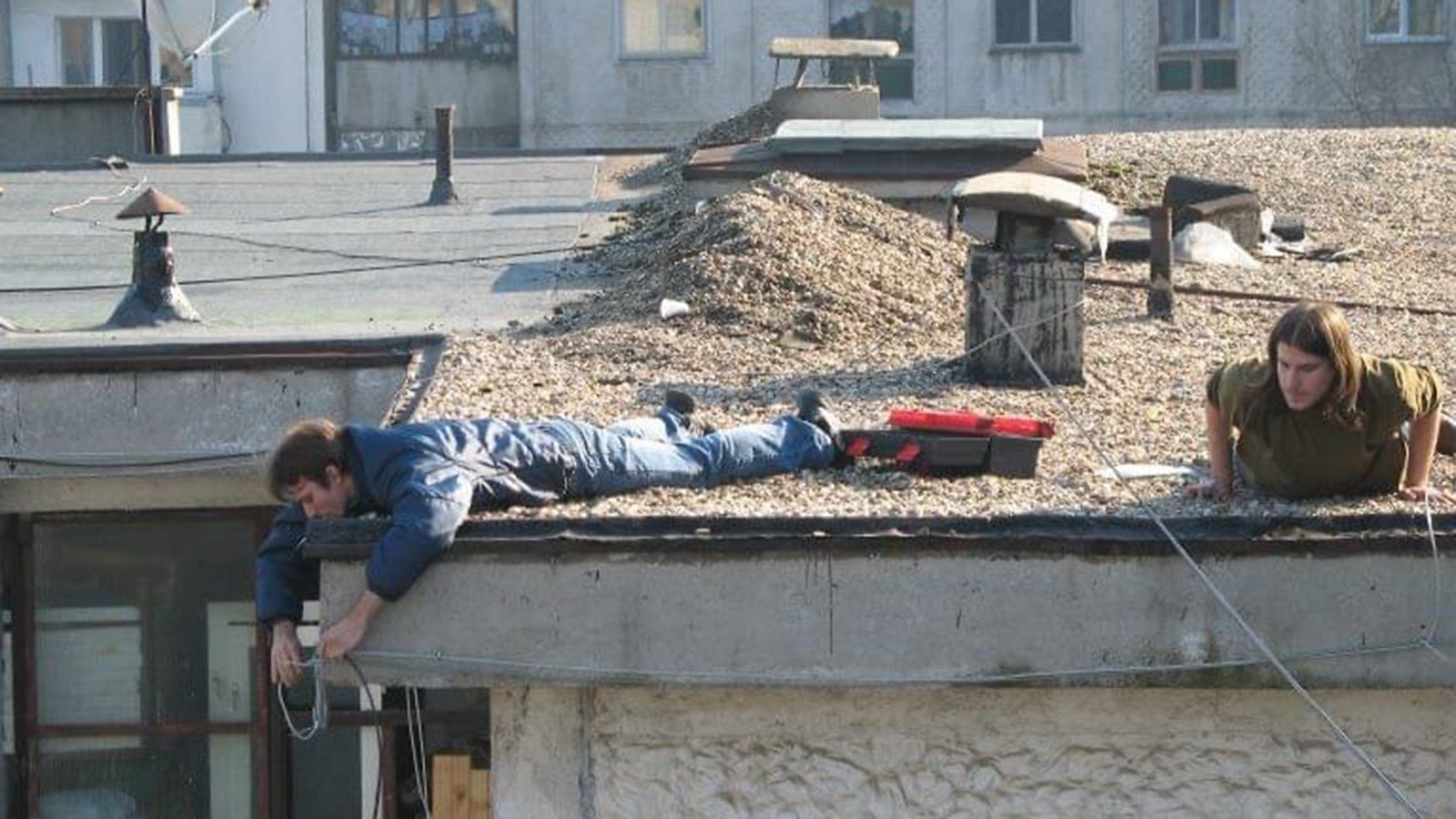
She was looking at a Facebook post from the Romanian Embassy to the US. The embassy had shared a BBC World Service documentary called The teenagers who wired Romania. The banner photo is the one above.
The one on the right, with the long hair, is me. As I remember it, I was guiding a cable. You can see a string, or another cable, tied to my left arm. The photo is from around 2003. I don’t know who took it, and until this week I had never seen it.
What were the chances? A picture I did not know existed went from somebody’s old camera to the BBC, then to an embassy page, then to my wife’s feed, more than twenty years later.
What the documentary is about
The BBC describes it better than I can: in the late 90s, teenagers in Bucharest were stringing computer cables between tower blocks to share an internet connection. It started scrappy and grew into an improvised network big enough to get the attention of the telecom companies.
I was one of many. Every neighbourhood had a few of us, and this is how it looked from my rooftop.
A time of hope, and a great hunger
To understand why teenagers were climbing on roofs with cable, you need a bit of context.
Romania was coming out of communism, which had been an aggressive cancer and had left the country in great poverty. What came after was a time of hope. Then the internet arrived with an explosion of information, and we had a great hunger for it. Everything we had not been able to read, hear, watch or learn was suddenly out there, if you could get online.
Getting online was the hard part.
Dial-up, if you were lucky
There was dial-up, but it was scarce. The telecom companies of that time were not ready to support it properly. Sharing one landline number between several families was fairly common, so the phone line was not even yours to keep busy.
If you did have access, it was not cheap and it was very slow. Think 2 to 3 KB per second, with a lot of lag. It was enough to see what was out there, and not enough to actually enjoy it.
First, the games
To be honest, the network did not start with the internet. It started with games.
Before we had a broadband contract, the main activity on those cables was playing. StarCraft, even over IPX/SPX. Need for Speed, Half-Life, Counter-Strike. And Quake, which I was a big fan of.
The other thing was chat. We had our own internal chat on the network. PowWow and Nessy are the two I still remember.
Quake is also one of the reasons I started learning Linux. Back then the main reason to stay on Windows was gaming. Quake ran on Linux with OpenGL, so that reason was gone, and I made up my mind to live in Linux.
So we teamed up
Broadband existed, but a connection cost far more than any one of us could afford. Our only chance was to share it.
So the goal was simple. Team up, find like-minded people, and get to the point where we could split one broadband connection between us. We started with ADSL and expanded from there.
Sharing a connection between apartments and buildings needs a decent network. Nobody was going to build it for us, so we kept building it. That is what you see in the photo: cable going from one block to the next, a toolbox on the gravel, and somebody leaning a bit too far over the edge.
Fun fact: drawing was a hobby of mine at that time, and I won a drawing contest for an anti-smoking campaign. The prize money went into UTP cable.
The best course I ever took
This was long before the Cisco CCNA and the Linux courses. Nobody was teaching us. We learned because the network had to work, and when it did not, the neighbours let us know.
It turned out to be a good school. It is where I picked up a passion for networking and for system internals, for knowing what actually happens underneath.
Still at it
Here I am, many years later. There are more abstraction layers now, and there is AI on top of them. The cables are somebody else’s problem and the roof is a cloud region.
The job has not changed that much, though. People need to be connected to something, there is never enough budget, and it has to work. I am still at it, and I still enjoy it.
If you have 26 minutes, listen to the documentary. And if you took that photo, or you are the one hanging over the edge, get in touch. I owe you a beer.
Photo: banner image of the BBC World Service documentary The teenagers who wired Romania. Photographer unknown.